Mithras
Vainqueur the DragonMithras is the sun god of law, justice, and healing, and one of the twelve gods of Outremonde. His decisive significance lies in the boundary he represents between divine authority and mortal action: although he possesses immense power and cannot die, he cannot simply intervene in the world’s wars. Instead, he claims and empowers mortal champions, turning Kia Bekele’s death into the beginning of a new destiny while binding that gift to the defense of Outremonde.
Identity and Appearance
Mithras appears as an immense archetypal king whose marble-like skin resembles a statue carved from stone. He wears a crown of flames, carries a blazing sword beneath a royal mantle, and possesses two suns for eyes. His physical design makes his jurisdictions visible: the sun expresses radiance and authority, while the crown and sword join kingship with judgment and enforcement. When he introduces himself to Kia, he identifies himself as the god of the sun, law, healing, and justice, speaking with a warm, booming voice rather than the cold or abstract manner of an impersonal cosmic force.
His status is also reflected in the temple of Haudemer. The temple’s great white hall contains a statue and altar for each of the twelve gods of the mortal races, but Mithras receives the greatest prominence. His giant marble image occupies the largest altar, depicting him as a crowned manling king wielding a blazing sword. A statue of Leone, goddess of art and nobility, stands beside him. According to Victor Dalton, Mithras and Leone are the titular deities of Gardemagne, which explains their central placement and connects Mithras’s divine identity to the kingdom’s public ideals of law, kingship, and justice.
Divine Role and Limits
Mithras is not an all-powerful deity who can end every crisis by decree. He explains to Kia that the gods are closer to the Olympians or the Aesir: powerful and immortal, but still limited. That clarification prevents divine authority from becoming an easy substitute for mortal courage. The gods have already learned the destructive consequences of direct intervention. A millennium earlier, they agreed not to fight on Outremonde itself because their conflicts caused more harm than good and produced no clear victor.
Their restraint is complicated by the presence of Sablar the World Eater, who supports the fomors in their campaign of universal destruction and prevents the gods from intervening freely. Mithras and Leone can therefore guide and empower mortals, but they cannot personally resolve the political and military crisis threatening the continent. Divine power operates indirectly through the Class System and through the claiming of souls from Earth. Mithras’s authority is consequently both elevated and constrained: he can open the path to heroism, but the champion must still act within the mortal world.
Kia Bekele and the Paladin Calling
Mithras encounters Kia Bekele in his heavenly realm after her death. She had expected death to lead to a dark void, but instead finds herself in a sacred environment where the gods receive and evaluate the dead. Mithras and Leone explain that dragons and fomors cannot be reincarnated through the ordinary process, while Kia, as a human, may be granted a new life and divine blessings. The opportunity is not presented as an unconditional reward. Kia is told that Outremonde faces an ancient enemy and that extraordinary power carries an obligation.
Mithras identifies that enemy as King Balaur, the strongest and foulest of the fomors. Balaur has raised a terrible army and wages war against the Mistral Continent; countries have already fallen, and Gardemagne, described as the stronghold of mankind, is threatened with destruction. Mithras warns that Balaur intends to drown the continent in the blood of mortals so that they can never rise again against the fomors. The mission offered to Kia is therefore not a private adventure but a response to a continental threat and to the possible restoration of mortal resistance.
Kia is initially less enthusiastic when the grandeur of the offer becomes clear, since she does not consider her former life heroic. She had moved from Ethiopia to Europe with her parents and died as a school student when her boyfriend crashed their car; her charity work was meaningful but did not seem to her like the deeds of a legendary champion. Mithras nevertheless refuses to define heroism only by a completed heroic past. He tells her that she can still become a hero and grow into a legend, and that even failure would not exclude her from a bountiful afterlife in his realm. His appeal combines duty with consolation: Kia may fight for Outremonde, but she is not promised that her worth depends entirely on victory.
The claiming becomes tangible when Mithras and Leone raise their hands toward Kia. Two symbols materialize as tattoos on the backs of her palms: a shining golden sun and a shield marked with a stylized pen. The signs join Mithras’s solar authority to Leone’s association with valor and nobility, while the Class System formally recognizes Kia by granting her a level in the prestigious Paladin Class. The accompanying increase of one point each in strength, vitality, charisma, and luck turns divine sponsorship into measurable power. Mithras thus functions as both theological patron and institutional gatekeeper, converting a soul from Earth into a Class-bearing agent of the gods.
Law, Worship, and Political Meaning
Mithras’s influence extends beyond Kia’s recruitment. His prominence in the Haudemer temple demonstrates that divine hierarchy is entangled with mortal politics. He and Leone stand at the center because they are associated with Gardemagne, whereas more ambiguous deities such as the Dread Three, Sablar, and Shesha are placed to one side, and the so-called politically correct gods, including the Moon Man, Seng, Cybele, Isengrim, and Dice, occupy the other. The arrangement makes the temple a map of competing religious and political interpretations rather than a neutral catalogue of gods.
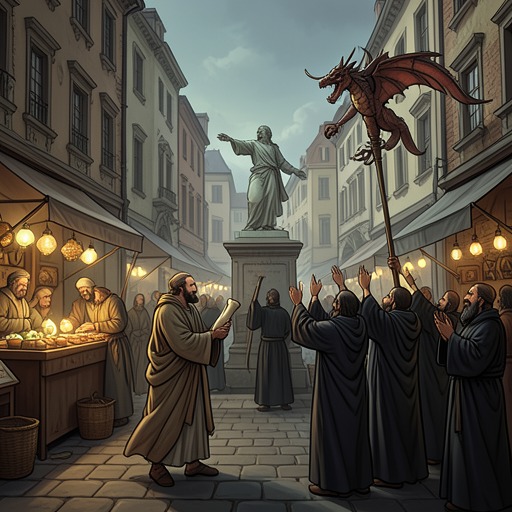
Mithras’s image also remains available for appropriation by rulers who do not share his restraint or ethics. Vainqueur Knightsbane recognizes the statue as belonging to the sun god of law and justice, yet his own imperial program turns public religion into spectacle. After the defeat of Furibon, he proposes Vainqueur Day, a feast, the burning of a wooden puppet of Furibon, and a statue of himself larger than the gods in the temples. Against that boastful project, Mithras’s monumental statue represents an older and more legitimate form of kingship, even though the narrative places both figures within the visual language of crowns, authority, and public awe.
Mithras’s legal symbolism also throws the book’s competing systems of obligation into relief. Elsewhere, institutions use contracts to authorize postmortem necromantic labor, while Vainqueur declares that no taxes will ever separate dragons from their hoards and later promises to protect treasures sent to him. These arrangements show law operating through churches, contracts, imperial commandments, and divine patronage. Mithras is not shown personally administering every rule, but his identity gives the language of law a cosmic reference point against which those mortal and monstrous legal orders can be measured.
Narrative Function and Significance
Mithras occupies the mentor and herald position in Kia’s threshold passage. He receives her after death, explains the structure of the world she is entering, names the threat that will define her new life, and grants the Class that makes her mission possible. Yet he is also an inversion of the all-solving god. His refusal, or inability, to fight directly means that the sacred realm cannot replace history; it can only send a champion back into danger with authority, symbols, and improved capacities.
The character therefore mediates several oppositions at once: life and death, heaven and the mortal world, divine law and political violence, and heroic destiny and ordinary biography. Kia’s passage from an unexpected death to Paladin status is not presented as proof that she had secretly been extraordinary. It is an act of claiming that creates a future obligation. Mithras supplies the sacred framework and the promise of meaning, but the burden of making that promise real remains with the mortal whom he empowers.